
How to Become a Prop Trader
A prop firm gives you an account to trade under a clear set of rules. At Pivex, that account is simulated and runs on real-time market data, so prices move as they do in the live market, but you are not trading your own capital. Pivex is not a broker and does not provide investment services.
To pass the Challenge, you reach a profit target while staying inside the loss limits. After you pass and verify your identity, you move to the Pivex Trader stage, where rewards depend on your own results.
That structure is useful when you are starting out. The rules tell you exactly how much you can lose in a day and in total, and putting numbers on both is a habit worth building from your first trade.
What to Know Before Your First Challenge
Read the rules before you place a trade. They are short, and each one affects how you should size and plan your trades.
| Rule | What it means | On a $10K account |
|---|---|---|
| Profit target | Reach 10% of the starting balance | $1,000 |
| Daily loss limit | 4%, renewed every trading day at 00:00 UTC | $400 |
| Maximum loss | 6% of the starting balance, static | $600, measured from $10,000 |
| Minimum trading days | At least 5 days with at least one trade each | Same on every size |
| Time limit | None | Same on every size |
| Consistency | Largest trading day under 50% of total profit | Your best day stays under half of your total profit |
The word static matters. Your maximum loss is set from the starting balance and does not move up as the account grows. If a $10K account climbs to $10,500, the limit is still $600 below $10,000, not below $10,500.
If an account crosses either loss limit, open trades close automatically and that account no longer counts toward the Challenge. You can start again with a new account, so a broken limit is a lesson rather than the end of the road.
Learn the Basics With Pivex Academy
Pivex Academy is included with every account. It has 4 modules and 18 short lessons with quizzes, about 1.5 hours in total, and you receive a certificate at the end.
Treat the Academy as groundwork, not a shortcut. It covers the basics, and the quizzes show you which ideas still need another read before real-time prices start moving against a position. Ninety minutes of study means you start your first Challenge knowing every rule.
A Plan for Your First 30 Days
Thirty days is a useful window. It is long enough to cover the 5 trading day minimum several times over and short enough to review honestly. Here is one way to use it.
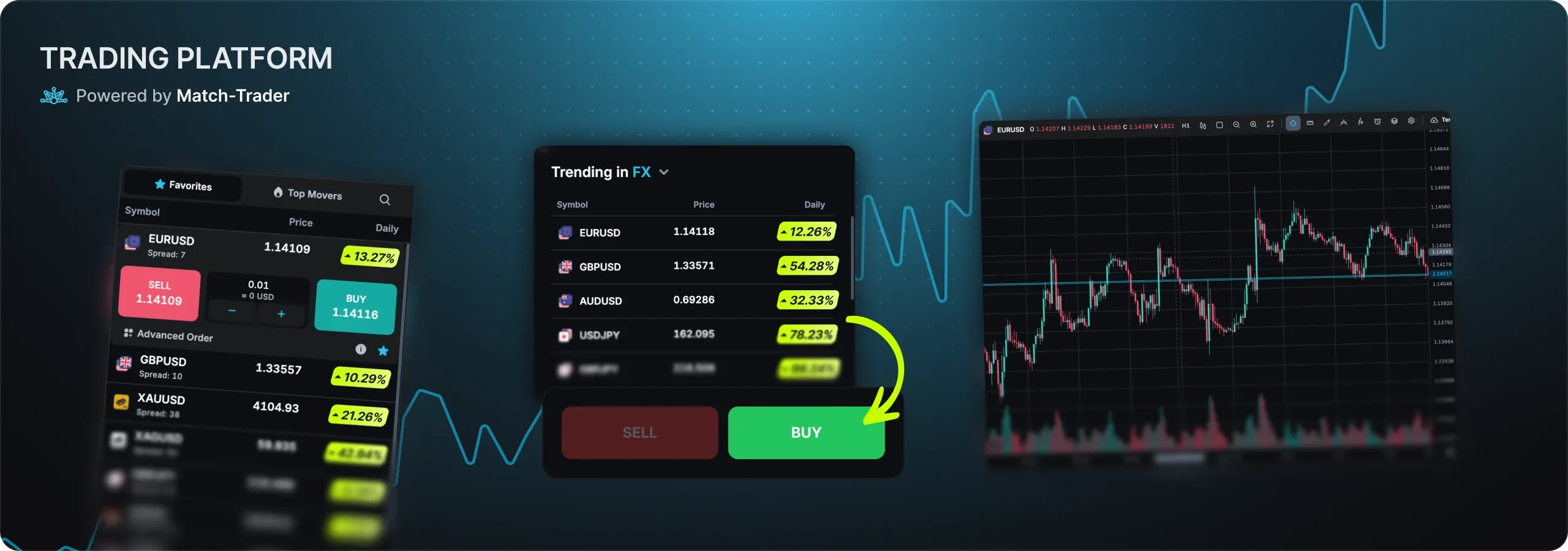
- 1Learn the platformOpen Match-Trader in your browser and learn where to place an order, how to set a stop loss and a take profit, and how to read your open positions. Find the Markets list and the Market Hours panel, and add the platform to your phone home screen if you want to check positions away from your desk.
- 2Pick one or two marketsFocus beats variety at the start. Major forex pairs such as EUR/USD trade 24 hours a day, five days a week, and gold (XAU/USD) is another widely followed market. Learn how your chosen market moves in different sessions before you add another.
- 3Trade smallStart with position sizes far below what the limits allow. Your goal in the first week is to place clean, planned trades, not to reach the target.
- 4Set your risk per tradeDecide in advance how much of the account you will risk on one idea. On a $10K account, risking 0.5% means $50 per trade, so it would take eight losing trades in a row to reach the $400 daily limit.
- 5Keep a journalWrite down every trade: the market, the reason, the size, the result and how you felt. After 20 or 30 trades, patterns appear that no chart will show you.
- 6Review and adjustIn the last week, read your journal from the start. Keep what worked, drop setups that keep losing, and only then think about trading a little larger.
Progress toward the target is welcome in the first month, but it is not the main goal. Knowing your own process is, because that is what carries over to every account you trade after this one.


